
Navratri Love Story AI Video: 2-Clip Prompt With Tenglish Dialogue
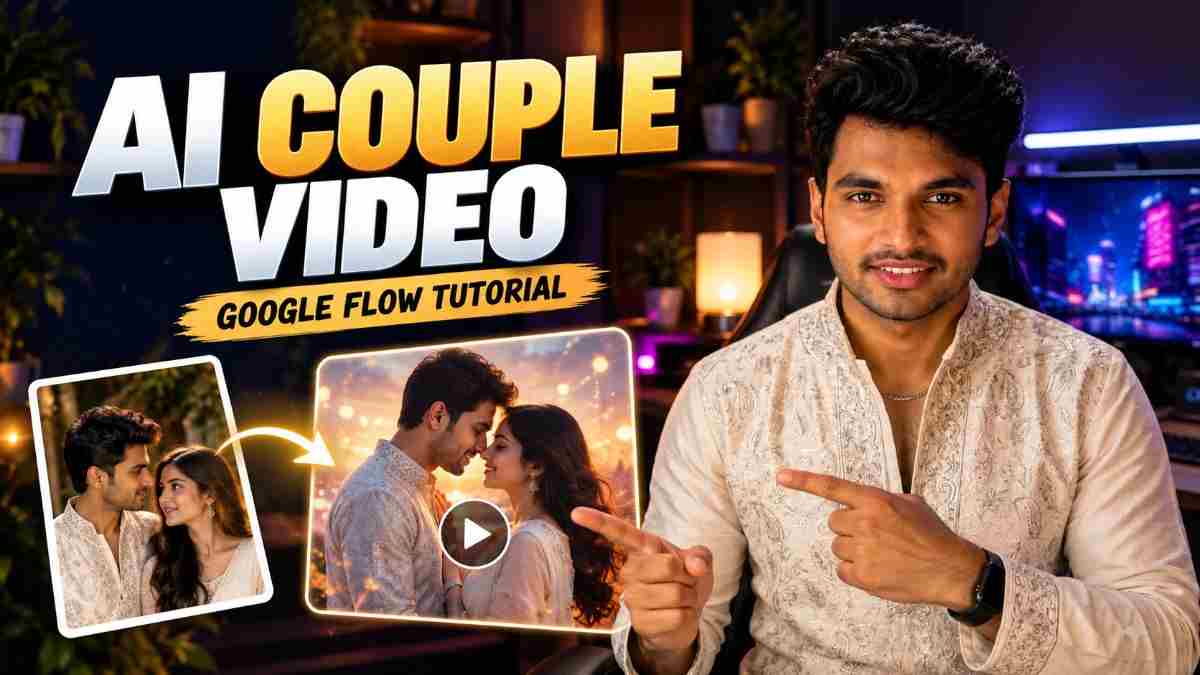
Most AI video prompts generate one clip at a time, but a story usually requires at least two: one that sets up the scenario, and one that replies. Here's how to make a 20-second Navratri love story video from two 10-second connected clips. The boy and girl keep the same faces and outfits and say short lines in Tenglish (Telugu written in English letters).
Focus here is on continuity: how to make Clip 2 start like the next 10 seconds of Clip 1, not a new iteration of the same story.
Regarding the dialogue: The Tenglish lines below are just examples. Write your own in the language mix your audience prefers and keep each one short. You'll want to listen closely to the audio, because lip-sync in Telugu can vary.
The Story in Brief:
Clip Time What Happens
1 0-10 s At a Garba ground, the boy spots the girl at the edge of the dance floor and asks why she isn't dancing
2 10-20 s The girl replies, the boy offers his hand and they walk to the dance floor together
Format: vertical 9:16, cinematic realism, night-time festival.
Before you begin
You'll need one reference photo of the boy and one of the girl. Only use photos of people who have consented, and be sure both are adults.
Choose well-lit, front-facing, clear photos.
Open Google Flow, upload the two photos as references, choose video and 9:16, and make sure of the credit cost before generating.
Generate Clip 1 first and select the best result, then use its last frame to generate Clip 2.
Clip 1
Prompt
✨ AI PromptCreate a 10 second ultra-realistic cinematic Gujarati Navratri love story video in vertical 9:16 format. STRICT FACE IDENTITY LOCK: Use the uploaded reference images as the exact identity references for the boy and the girl. Preserve their exact faces, facial features, skin tones, hairstyles and natural appearance in every frame. No face swapping, face morphing, beautification or identity drift. BOY: Adult Indian man wearing an elegant black kurta, black trousers and black mojari shoes. No glasses or sunglasses. GIRL: Adult Indian woman wearing a colourful mirror-work Gujarati chaniya choli, traditional jewellery and open wavy hair. SETTING: Grand Gujarati Navratri festival at night, colourfull lights, traditional dancers and energetic Garba music. SHOT 1 (0-2 sec): Wide establishing shot of the vibrancy Garba ground filled with people dancing. SHOT 2 (2-4 sec): Medium shot of the girl at the edge of the dance floor, holding dandiya sticks and watching the dancers. SHOT 3 (4-6 sec): The boy dances with friends, notices the girl and pauses with a curious smile. SHOT 4 (6-7 sec): Side-tracking shot as the boy walks towards the girl through the festival crowd. SHOT 5 (7-10 sec): Chest-up two-shot. The boy looks at the girl and asks in natural Tenglish: BOY: "Ninnu rendu rojula nunchi notice chesthunna... nuvvu Garba enduku aadatledu? Neeku ishtam leda?" The girl looks at him with a slight, curious smile and is ready to answer in the next clip. She does not speak yet. AUDIO AND ENDING: The boy must finish the whole question before the clip ends. Natural Telugu-English pronunciation, accurate lip-sync, no rushed words, no overlapping voices. Keep background music low during dialogue. End with both characters facing each other, eye contact held. Hold the final frame briefly so Clip 2 can continue. No additional dialogue, no repeated lines, no subtitles, no text, no watermark.
Save the Last Frame
When Clip 1 looks good, pause on its final frame and save the image. This is the bridge to Clip 2.
Fix for Changing Outfits: Turn On Agent Mode
The most common issue with multi-clip stories is that the outfits change in Clip 2, even with a strong prompt. What fixed it for me was turning on agent mode in Google Flow before generating the second clip. Menus and placement can change, so keep looking for the agent option in your Flow screen. If you don't see it, check Google's current Flow help or whether your plan includes it.
Then the following order:
-
Turn on agent mode.
-
Add the saved last frame of Clip 1 and original character photos.
-
Paste the Clip 2 prompt below.
-
Compare the outfits with Clip 1 before using the result.
Agent mode helps, but it doesn't rule out outfit changes altogether. Always check the result.
Clip 2(Strict Continuation)
Prompt
✨ AI PromptUpload the saved last frame, plus the original reference photos and then use: Create a 10 second ultra-realistic cinematic Gujarati Navratri love story video in vertical 9:16 format. CONTINUE FROM VIDEO 1: Use the uploaded final frame of Video 1 as the starting frame. Continue directly from that moment, with the same two adult characters facing each other at the same Navratri festival. Use the original reference photos for identity, and Video 1 for appearance, age, clothing, jewellery, hairstyle, body proportions, lighting and location. Do not redesign or regenerate the characters. Continue the existing characters. FACE IDENTITY AND ADULT AGE LOCK: Both are adults, the same age as in Video 1. Preserve the exact faces from Video 1 and the reference photos. Keep mature adult facial proportions. Do not make either character look younger. Do not change facial geometry, eye shape, nose, lips, jawline, skin tone or hairline. No face morphing, identity drift or beauty filter. Natural expressions are fine; changes to identity or apparent age are not. OUTFIT CONTINUITY: BOY keeps the same black kurta, black trousers and black mojari shoes, with no glasses. GIRL keeps the same mirror-work Gujarati chaniya choli, jewellery, earrings, bangles and open wavy hair. Do not recolour, simplify or replace any clothing or accessory. SHOT 1 (0-2 sec): Same chest-up two-shot. The girl smiles shyly and says in Tenglish: GIRL: "Ishtame... kaani naatho kalisi aadadaniki evaru leru." SHOT 2 (2-5 sec): The boy smiles warmly, extends his hand and says: BOY: "Aithe, nenu unna kada... ee Navratri manam kalisi Garba aadadhaam." SHOT 3 (5-7 sec): The girl smiles, places her hand in his and says: GIRL: "Sare... padha!" SHOT 4 (7-10 sec): They turn towards the lit Garba dance floor, hand in hand, and walk together. End on a romantic medium-close shot with the same faces and outfits. CAMERA AND AUDIO: Cinematic realism, warm Navratri lighting, colourfull festival bokeh, realistic skin texture. Prefer medium and medium-close shots; avoid extreme close-ups and lens distortion. Dialogue order is girl, boy, girl, each line spoken once with clear pronunciation, natural pauses and accurate lip-sync. Lower the music during dialogue. NEGATIVE PROMPT: childlike face, younger-looking characters, oversized eyes, altered jawline, face morphing, identity drift, different people, different clothes, recoloured outfits, missing jewellery, new accessories, hairstyle changes, duplicate characters, repeated dialogue, audio lag, subtitles, text, watermark. FINAL PRIORITY: Video 2 must look like the next 10 seconds of Video 1, not a new version of the story.
Why This Two-Clip Method Works
Last frame as the bridge. The model starts Clip 2 from the exact pose, light and outfit it just made. Much more stable than describing the characters from scratch.
Both a frame and the original photos. The frame holds the look of Video 1, and the original photos holds the true faces. Using both reduces gradual drift across clips.
An age lock. In some continuation clips, faces can start to look younger or softer. Saying "adult, same age as Video 1" and listing what to avoid helps.
A "does not speak yet" line. Clip 1 ends with the girl silent so the dialogue does not run past 10 seconds or overlap.
One line per speaker, in order. Writing the order (girl, boy, girl) and "each line spoken once" cuts repeated lines.
Agent mode on. In my tests this made the biggest difference to outfit consistency between clips.
Tips for Cleaner Dialogue
Keep every line under about 12 words. Long lines get rushed.
Write Telugu words in simple spellings (because spelling affects pronunciation).
If a line is mispronounced, regenerate only that clip.
Add subtitles in an editor afterwards, rather than asking the model to render them.
Lower music in the edit as well, if the voices are masked.
Adapting This Story
Another festival: change the setting and outfits, for example Bathukamma or Diwali.
Another language: rewrite the three lines in Hindi, Tamil or English.
A third clip: give Clip 3 the same continuation block, using the last frame of Clip 2.
A single character: remove the second character and the dialogue lines.
Responsible use
Only use photos of adults who have agreed.
Label the video as AI-generated when you post it.
Do not present it as real footage of real people at a real event.
My Experience With the Two-Clip Method
The problem I ran into was in Clip 2: the outfits kept changing. Clip 1 looked good, but in the next clip the boy's kurta or the girl's chaniya choli would come out slightly different, even though the prompt repeated the outfit description. Rewriting the prompt with stronger outfit rules didn't fix it reliably.
What solved it for me was turning on agent mode in Google Flow before generating Clip 2, and then giving it the Clip 1 last frame and the original photos. With agent mode on, the outfits stayed the same between clips far more consistently than when I generated without it. I still check every clip, but I now start with agent mode on for any story with more than one clip.
The dialogue was the other challenge. Short lines gave better lip-sync than long ones, and the first line needed the most retries because the model sometimes rushed the end of the question. Regenerating just that clip was cheaper than rebuilding the whole story.
Frequently asked questions
Can I make a story longer than 20 seconds?
Yes. Repeat the same method: save the last frame of each clip and use it as the starting frame for the next.
Do I need two reference photos?
For two characters, yes. One photo per person gives the best identity match.
Why does the face change between clips?
Models can drift when they regenerate. Use the last frame plus the original photos, keeping the identity lock block in every clip.
Why do the outfits change in Clip 2?
It is a common drift problem. Turning on agent mode in Google Flow, then adding the last frame and the original photos, worked best for me. Always compare the outfits before using the clip.
Can I write the dialogue in English or Hindi?
Yes. Replace the three lines and keep them short.
Will the lip-sync be perfect?
Not always. Check the clip, and regenerate if a line is rushed or cut off.
Is it okay to use photos of friends?
Only with their clear permission.
How many credits will it use?
It depends on your plan and settings. Check the cost shown on screen before generating.
Conclusion
A two-clip story works when Clip 2 begins where Clip 1 ended. Lock the faces and outfits, save the last frame, keep the dialogue short and in order, and regenerate only the clip that fails. With that method, 20 seconds of connected story is realistic.
Written by Dinesh, full-stack developer and content creator testing AI video prompts for real-world use.
DINESH
Lead EditorEditorial expert testing, curating, and documenting the best AI tools, gadgets, creative setups, and lifestyle gear in India.
Continue Reading
Recommended Stories
Navratri Garba AI Video Prompt
Face-locked Navratri Garba AI video prompt for Google Flow: a 12-second, 6-shot dance sequence with camera settings and a negative prompt.
Why Your Instagram Reels Get No Views: How to Analyze Using ChatGPT
Struggling with low Instagram Reels views? Learn how to use ChatGPT AI to analyze your profile and latest five Reels Insights, identify recurring mistakes, and discover practical tips to improve your content strategy.
20 viral ai food animation video prompts omni flash
Create viral-style AI videos in just 2 minutes using Google Flow! 🎬✨ Learn the simple steps to generate amazing videos with AI prompts and discover 15+ ready-to-use video concepts for your next viral reel.