Google Gemini FPV Drone Prompt: Create Cinematic AI Drone Videos Like a Professional (2026)
Introduction
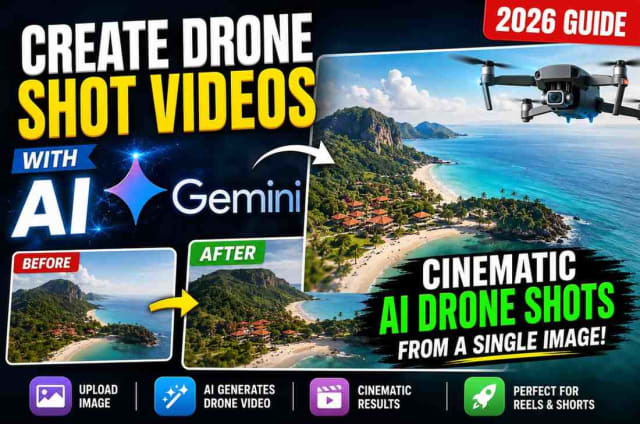
Artificial Intelligence has revolutionized the way content is created. Creating FPV drone videos used to require expensive equipment and professional editing skills, but now, anyone can leverage Google Gemini and the right prompt to turn a still image and precise camera directions into a stunning cinematic drone video in no time. One such prompt is the Google Gemini FPV Drone Prompt which allows creators to produce stunning first-person-view (FPV) drone videos with ease.
As we advance further into 2026, this prompt has gained immense popularity among content creators due to its ability to provide cinematic quality, realistic FPV movement, quick production, no need for a drone license, no travel, etc.
This article discusses what the Google Gemini FPV Drone Prompt is, how it works, and why it has become so popular among YouTube creators and social media influencers. It also covers the best practices while working with it.
What is the Google Gemini FPV Drone Prompt?
The Google Gemini FPV Drone Prompt is an advanced prompt which is utilized to generate realistic first-person-view (FPV) videos using a reference image as a guide.
Unlike other prompts which would allow Gemini to utilize random camera angles and directions for generating the video, the Google Gemini FPV Drone Prompt specifies how Gemini should move the camera in order to replicate an FPV drone perspective. Furthermore, it also instructs Gemini to maintain all relevant visual aspects of the image in order to create a realistic drone flight.
Some of the relevant visual aspects preserved by this prompt include:
- Architecture
- Buildings
- Roads
- Perspective
- Skyline
- Lighting
- Atmosphere
- Color
- Scale
- Composition
Why are content creators using this prompt?
With social media algorithms favoring high engagement in the first few seconds of a post, having an attention-grabbing first-person view (FPV) drone shot is essential. With this prompt, one can generate a realistic FPV drone video without having to spend thousands of dollars on high-end drones and equipment.
Advantages
- Cinematic quality
- Realistic FPV movement
- Quick production
- No drone license
- No travel
- No weather
- Easy experimentation
- Consistent quality
- Perfect for Instagram reels
- Perfect for YouTube shorts
- Perfect for commercial videos
That is why this prompt has become so popular among content creators.
How does this prompt work?
This prompt works by taking a reference image as the foundation of the video.
By analyzing the reference image, Gemini would be able to pick out the following visual aspects:
- Building location
- Object location
- Camera perspective
- Lighting
- Road placement
- Architectural structure
- Background depth
- Atmosphere
By analyzing the reference image, Gemini would replicate the camera instructions as specified by the Google Gemini FPV Drone Prompt. Unlike other prompts which allow Gemini to randomly generate the camera directions, this prompt specifies that Gemini should keep moving the camera throughout the video in order to replicate an FPV drone movement.
Continuous Camera Movement
One of the most important aspects of this prompt is continuous camera movement.
By utilizing this prompt, one can avoid the following:
- Hidden cuts
- Hidden transitions
- Teleportation
- Hidden jumps
- Viewpoint reset
- Hidden movement
Instead, one would be able to replicate continuous camera movements as seen in first-person-view (FPV) drone videos. Thanks to this feature, generated videos would have an incredible level of realism as the camera replicates the inertial movements of a drone.
Some of the camera inertial movements replicated by this prompt include the following:
- Inertial movements
- Banking
- Acceleration
- Deceleration
- Pullback
- Climbing
- Rising vertically
Flight Sequence
This prompt also specifies the flight sequence which Gemini should follow while generating the video.
The flight sequence typically begins with a slow drone flight at a low altitude which takes the viewer past foreground buildings. The drone would then move in a sweeping movement towards the building while maintaining a strong forward direction for most of the flight.
The drone would then accelerate towards the building in front of the camera before initiating a continuous vertical climb. Throughout the climbing motion, the drone would continue to roll continuously in a spiral movement in order to maintain a strong forward direction. Once the drone reaches the topmost point of the climb, it would begin to pull back continuously in order to fully capture the environment. The flight would then conclude with a cinematic reveal of the environment as the drone ends its flight sequence. Since all movements were continuous throughout the flight, the generated video would appear incredibly realistic and would replicate the camera movements of a real drone.
Professional Camera Style
This prompt also replicates the camera style of a professional first-person-view (FPV) drone video.
- First-person-view (FPV)
- Professional FPV flight
- Smooth banking
- Consistent horizon
- Realistic speed
- Continuous forward direction
- Cinematic acceleration
- Natural camera inertial
- Strong foreground parallax
- Natural spatial continuity
Thanks to the stylistic choices incorporated by this prompt, videos generated by it would appear incredibly realistic.
Visual Quality
Perhaps one of the most impressive aspects of this prompt is its incredible visual quality.
The visual style of the videos generated by this prompt focus on the following visual aspects:
- Ultra-photorealism
- HDR
- 8K
- Realistic shadows
- Realistic reflections
- Atmospheric haze
- Premium architectural features
- Natural lighting
- Physically accurate scale
- Cinematic colors
These visual aspects greatly enhance the visual appeal of videos generated by this prompt.
Best use cases for the Google Gemini FPV Drone Prompt
Thanks to the incredible level of realism and dynamic camera movement, the Google Gemini FPV Drone Prompt can be utilized for a wide range of purposes.
Some of the best use cases for this prompt are as follows:
- Travel Vlogs
- Tourism
- Real Estate
- Luxury Listings
- Hotels
- City Reveal
- Landmarks
- Resorts
- Promotional Events
- YouTube intros
- Commercial
- Social Media Reels
- Architectural
- Cinematic edits
Since this prompt replicates the first-person-view (FPV) of a drone flight while maintaining a high level of environmental realism, it can be utilized for generating promotional videos of different destinations and locations. It can also be utilized for generating social media content and cinematic edits for YouTube videos.
Tips for using this prompt
In order to utilize the Google Gemini FPV Drone Prompt effectively, one should consider the following tips:
- Always use high-quality images as references. Low-quality images would often yield poor results. It is also important to ensure that the image has foreground, middle ground, and background in order to allow Gemini to generate depth in the generated video. Furthermore, always provide specific instructions rather than generic instructions, and ensure that lighting remains consistent throughout the video.
Other considerations while working with this prompt include the following:
- Experiment with different camera speeds while maintaining realistic movement
- Always review the generated videos in order to make necessary adjustments to the prompt
- Always make minor adjustments to the prompt in order to observe the changes
Common mistakes to avoid
While working with this prompt, it is important to avoid the following mistakes in order to ensure that the results are up to standard:
- Using low-resolution images
- Using poorly-lit images
- Using overexposed images
- Unrealistic camera speed
- Random camera movement
- Changing environment too much
- Visible artifacts
- Hidden cuts
- Unrealistic building distortion
- Excessive fisheye
- Flickering
By avoiding these common mistakes, one would be able to get better results with this prompt.
Why is this prompt different?
Unlike other prompts which merely instruct Gemini to generate a drone video, the Google Gemini FPV Drone Prompt specifies camera movement and environment in great detail in order to recreate a first-person-view (FPV) of a real drone. This allows one to create incredibly realistic videos with dynamic camera movements.
For creators who want to generate Hollywood-level AI drone videos with minimal effort, the Google Gemini FPV Drone Prompt is arguably one of the best prompts available in 2026.
Final Thoughts
Google Gemini FPV Drone Prompt represents the future of AI video generation. By utilizing a reference image along with specific first-person-view (FPV) camera directions, this prompt allows one to generate incredible cinematic drone videos with dynamic camera movements. Whether one wants to generate travel content, architectural content, or social media content, the Google Gemini FPV Drone Prompt is essential to one’s content creation process as it enables one to generate high-quality videos with minimal effort. As Google Gemini advances and improves, learning how to use advanced prompts such as this one becomes essential to one’s success.
PROMPT
✨ AI PromptUse @img as the master visual reference for the entire video. Preserve the exact environment, skyline, building positions, architecture, roads, lighting, atmosphere, colors, perspective, scale, and composition. Do not modify the environment or introduce new buildings or landmarks. Use ONLY as a storyboard and camera choreography reference. The route lines, arrows, numbered checkpoints, storyboard panels, text, diagrams, graphs, and all UI elements are planning guides only. They must NOT appear in the final video. Create a hyper-realistic cinematic FPV drone sequence lasting approximately 15 seconds. The entire sequence must be one continuous uninterrupted FPV drone shot from the first frame to the last. There must be no cuts, hidden transitions, camera resets, teleportation, disconnected movements, or abrupt viewpoint changes. Treat the route shown in as a continuous camera spline. Follow the camera path precisely, preserving every curve, banking turn, climb, descent, spiral, pullback, altitude change, and direction exactly as illustrated. Do not simplify the route, skip sections, reinterpret the movement, or create shortcuts. Every segment of the route must connect seamlessly to the next while maintaining realistic FPV drone momentum and continuous spatial orientation. Match the timing and progression demonstrated in the storyboard panels. Flight Sequence • Begin with a low-altitude entry through the foreground buildings. • Perform the sweeping approach around the foreground structures while maintaining strong forward momentum. • Accelerate toward the central subject exactly as shown. • Transition into a smooth vertical climb while staying close to the structure. • Continue into a single continuous spiral climb around the structure while maintaining upward momentum. • Pass above the highest point without stopping. • Transition into a wide pullback arc while continuing to gain altitude. • Finish with a dramatic wide aerial reveal matching the final storyboard composition. Camera style Professional FPV drone First-person perspective One continuous take Ultra-high-speed cinematic flight Physically accurate FPV drone movement Realistic inertia Continuous forward momentum Smooth banking during turns Natural acceleration and deceleration Stable horizon Strong foreground and background parallax Immersive sense of speed Continuous spatial continuity Visual Style Ultra-photorealistic Cinematic HDR 8K quality Realistic lighting Natural shadows Accurate reflections Atmospheric haze Highly detailed architecture Physically accurate scale Premium drone cinematography Critical Instructions The storyboard in 2 defines the exact camera choreography. The route line is a continuous camera trajectory, not a loose direction guide. Follow the storyboard timing and movement exactly. Maintain one uninterrupted continuous flight. Preserve the environment from @a5bc0487-d56e-45a1-aae3-524321b528001 exactly. Negative Prompt Do not render the route lines, arrows, numbered markers, storyboard panels, text, graphs, UI elements, overlays, watermarks, or guide marks. Do not duplicate buildings, distort architecture, change the environment, introduce AI artifacts, flickering, camera jumps,unrealistic motion, excessive fisheye distortion, or hidden cuts.
dinxsh7
EditorEditorial contributor researching practical guides, tech discoveries, and curated recommendations for Dinesh Picks.
Continue Reading